The Immortals
This is the final entry in my overview of the early Achaemenid Persian army and concentrates on the Immortals themselves.
As mentioned in Part 1, Herodotus is really the only ancient source to mention them by name. So, exactly who or what the Immortals were is difficult to pin down. Some have asserted that the corps of Immortals was formed by Cyrus the Great following his victory over the Neo-Babylonian King Nabonius in the battle of Opis, 539BC, but there is no direct evidence for this.
 |
| The famed Immortals |
Even Herodotus’ use of the term Immortals is ambiguous. It has been conjectured that Herodotus heard the Old Persian word anûšiya (“companions of the King”), a term testified certainly in Persian texts and confused it or associated it with the phonetically similar Persian word anauša (“Immortals”).
Either way, Herodotus has appended the title ‘Immortals’ to this unit of 10,000 men and it’s stuck. However, the Iranian name for this unit remains unknown because authentic Achaemenid sources with this information do not exist.
 |
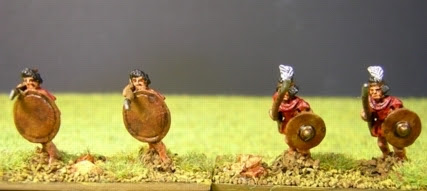
| Iranian infantry that fought in a combined spearman and archer formation |
So, what do we know about these Immortals? I'm going to approach the role of the Immortals from the angle of Persian Imperial identity (as discussed in Part 2) which centred around proximity to the King of Kings as he traveled incessantly around the centre of the empire.
Proximity to the King was power. Militarily closest to the King were his personal bodyguards known as Kinsmen or Apple-bearers, who were chosen for their bravery and loyalty from the Persian nobility, often the king’s relatives.
It’s not entirely certain, but these are probably the two 1,000 strong units each of picked infantry, described as spear-bearers (men with golden apples on their spear butts and men with golden pomegranates on their spear butts) and two 1,000 strong units of cavalry that Herodotus mentions in his account of the invasion host crossing the Hellespont.
They are the true Achaemenid elites, they are not the Immortals.
 |
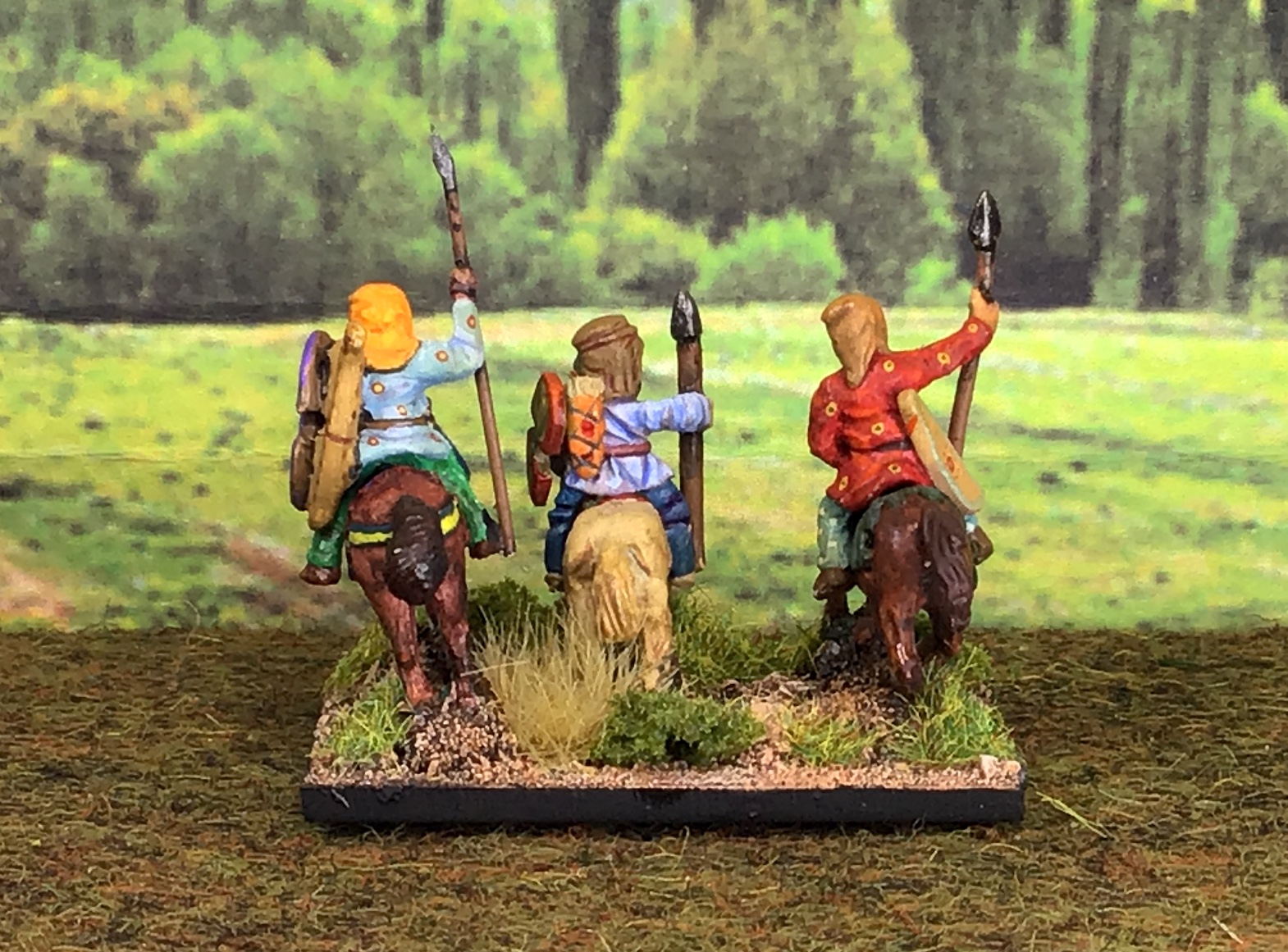
| Some Persian cavalry |
At the next remove from the King were 10,000 Persian foot soldiers that Herodotus names as the Immortals plus a further unnamed 10,000 Persian cavalry. His descriptions of their luxurious accoutrements speaks to their status. The fact that they are never allowed to fall under an establishment strength of 10,000 (thus the unit is ‘immortal’) speaks to their importance in the Persian military.
 |
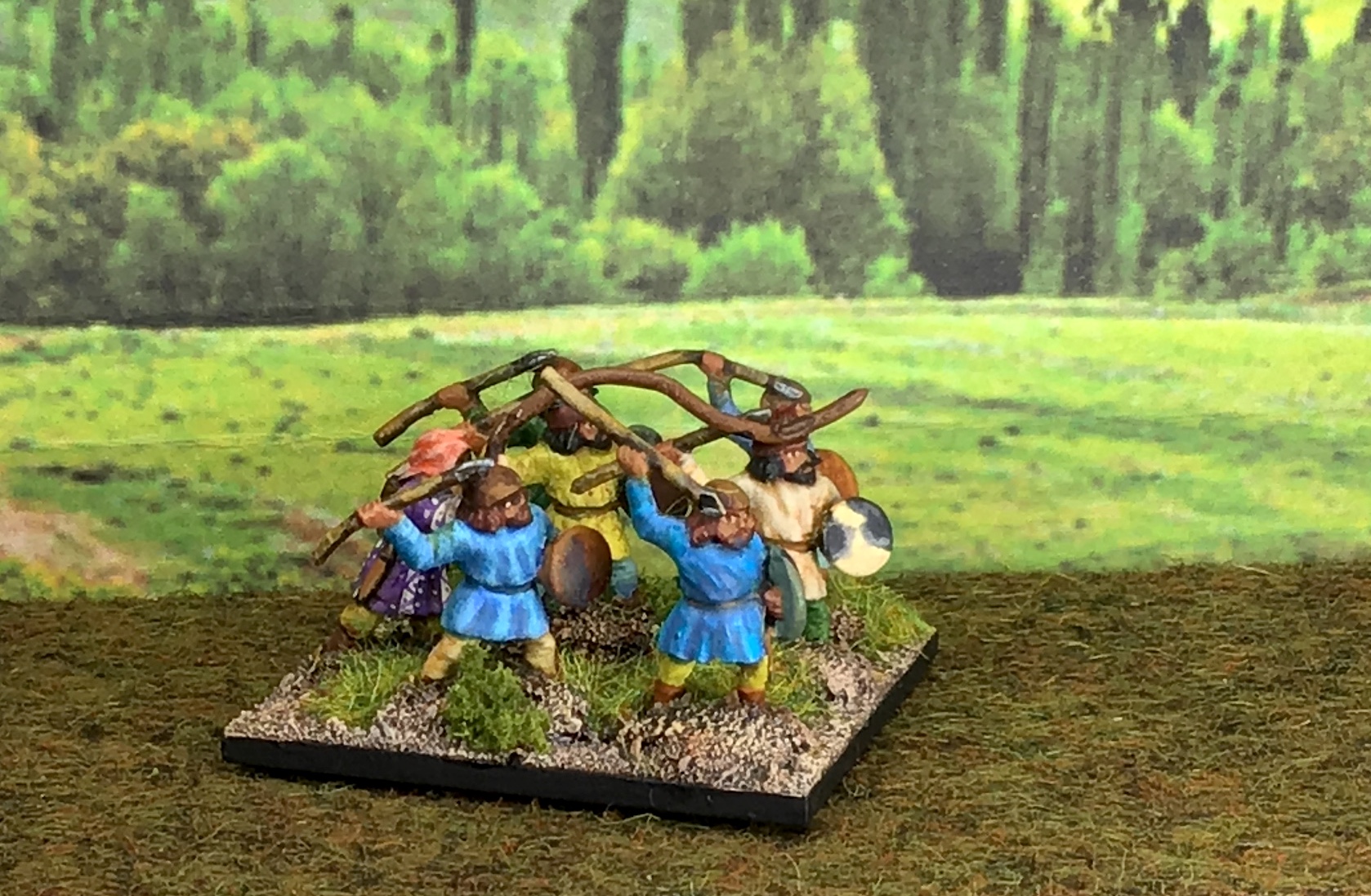
| Pactyan archers. Herodotus' 15th corps of Xerxes invasion force |
The Immortals (and presumably those unnamed 10,000 Persian cavalry) were the Achaemenid Persian’s standing army. They formed the permanent backbone of Persian military capacity, selected from a well trained cadre of Persian men (and presumably, but to a lesser extent, Medes and other ethnic Iranians).
Exactly how they were recruited (or whether they received any special training) is unknown but personal bravery and honour were highly valued by the Persians. It is well documented that the Great King positioned watchers to report on and reward those who acted with particular valour in battle, so perhaps this formed part of the recruitment process.
 |
| Paphlagonian and Matieni levy troops. Hordes in DBA |
The Appearance of the Immortals
Although the beautifully coloured glazed reliefs at Susa (often said to be Immortals but there’s no direct evidence for this) depict guardsmen with the distinctive flowing ‘Persian’ robes, Persian soldiers in Greek art and literature are overwhelmingly in ‘Median’ dress of trousers and tunics.
 |
| Guardsmen from the palace at Susa |
According to Herodotus, the Immortals wore loose felt caps called tiaras, on their heads, colorful, long sleeved tunics and trousers.
He says they carried a 6-8 foot spear, a large bow, a dagger and a leather covered wickerwork shield under which hung a quiver. They were also conspicuous for the huge amount of gold they wore on their person.
 |
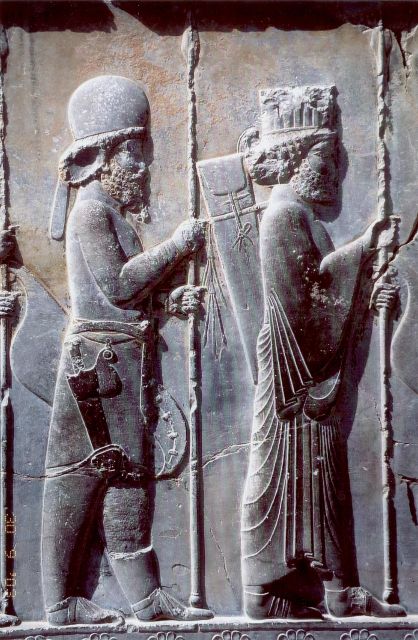
| Soldiers from Persepolis |
At one point, Herodotus describes the Immortals / Persians as wearing iron, fish-scale cuirasses (perhaps worn under their tunics) as well as linen ‘Egyptian’ cuirasses.
Confusingly, Herodotus later attributes the reasons for Persian defeat to the lack of armour. The reason for this may be that by the battle of Plataea, the Persians were forced to discard their body armour due to its deterioration.
There is a small amount of evidence that the Immortals wore uniforms. Athenaeus, writing in the early 3rd century AD, says that the Apple Bearers wore purple and yellow tunics, Archers wore flame colour and dark blue while Susians wore yellow by itself. Xenophon ascribed purple and walnut red uniforms.
There are also indications that the spears of the Immortals had Silver pomegranate butt-spikes while the King’s bodyguard units had golden apple or pomegranate butt-spikes.
The Persian King and his ever travelling court were the epicentre of the Empire, grandly displaying royal authority and projecting its military power. It was the Immortals who were the visible and potent aspect of this power.
Beyond these permanent forces, the King of Kings could call upon the levied forces of the empire. Medes and other ethnic Iranians formed the core of this impermanent levy and were given commensurate responsibilities in battle. Persian and Skythian troops formed the successful centre of the Persian battle line at the battle of Marathon. While at Thermopylae, the Persian attacks centred around the combined Medes and Cissians (and the Immortals).
It comes, therefore, as no surprise that for the Plataea campaign Mardonius chose as the nucleus of his army the Immortals as well as 1,000 Persian Spear bearer troops, the flower of the army and the 1,000 picked cavalry squadron as well as 10 000 Medes (described as the same number but not quality as Immortals),
 |
| Medes foot soldiers. |
So, this then is the model of the Achaemenid Persian armed forces. Almost everyone in the empire paid taxes for the upkeep of the army and for employing the various mercenary forces garrisoning the empire. Satraps maintained only small forces, often ethnic Iranians.
The core of the Persian army traveled with the King of Kings. The Kinsmen were the flower of the army, men closest to the king and expected to defend him with their lives.
The Immortals (and maybe those enigmatic 10,000 Persian cavalry) formed the empire’s permanent army. Ethnic Iranians were trained to at least a basic level of competence and could be called into service as infantry and/or cavalry when needed. The rest of the empire provided troops when levied.
Later Achaemenid Persian Armies
After Xerxes’ failed invasion Persian recruitment practices remained much the same but there were clearly changes to the mix of the Persian army, at least in the west. Mercenary hoplites begin to be recruited in larger numbers; the importance of cavalry increases while Persian sparabara infantry are replaced by units like kardaces and takabara that appear to be hoplite and peltast analogues.
 |
| Milyae light infantry from Herodotus' 25th corps of Xerxes invasion force |
Neither the Immortals nor any similar military unit are mentioned in Greek sources after Xerxes campaign. Not in the army of Artaxerxes II at the battle of Canaxa (404 BCE) against his rebellious brother Cyrus the Younger, nor in any of the battles against Alexander the Great. Apple-bearers are mentioned as bodyguards of the King in battle but these are the select kinsmen of the Persian inner court. So exactly what the post invasion ‘Immortals’ looked like is unknown.
 |
| Immortals ready to do battle |
As a final note and apology of sorts to Herodotus, I’d just like to put this idea out there. Is it just possible that the Father of History was linguistically canny? Was he fully aware of both the Persian words anûšiya and anauša and developed a clever wordplay to emphasise the inestimable wonder to Greek eyes of a permanent force of 10,000 infantry? The famed Immortals were the central military force of the most successful empire of its era and should be recognised as such, be they the ultimate elites of myth or not.
Part 1 Part 2 Part 3
Further Reading
Immortals and Apple Bearers: Towards a better Understanding of Achaemenid Infantry Units. - Charles, Michael B
King of the Seven Climes - Lloyd Llewellyn-Jones
King and Court in Ancient Persia 559 to 331 BCE - Lloyd Llewellyn-Jones
https://www.livius.org/articles/concept/immortals/
The Achaemenid Army - Professor A. Sh. Shahbaz
The Administration of the Achaemenid Empire - Christopher Tuplin
The Military Dimension of Hellenistic Kingship. An Achaemenid Inheritance? - Christopher Tuplin
The Persian Military Establishment in Western Anatolia: A Context for Celaenae - Christopher Tuplin
War and Peace in Achaemenid Imperial Ideology - Christopher Tuplin
‘Neither the Less Valorous Nor the Weaker’ Persian military might and the battle of Plataia - Franz Steiner Verlag